
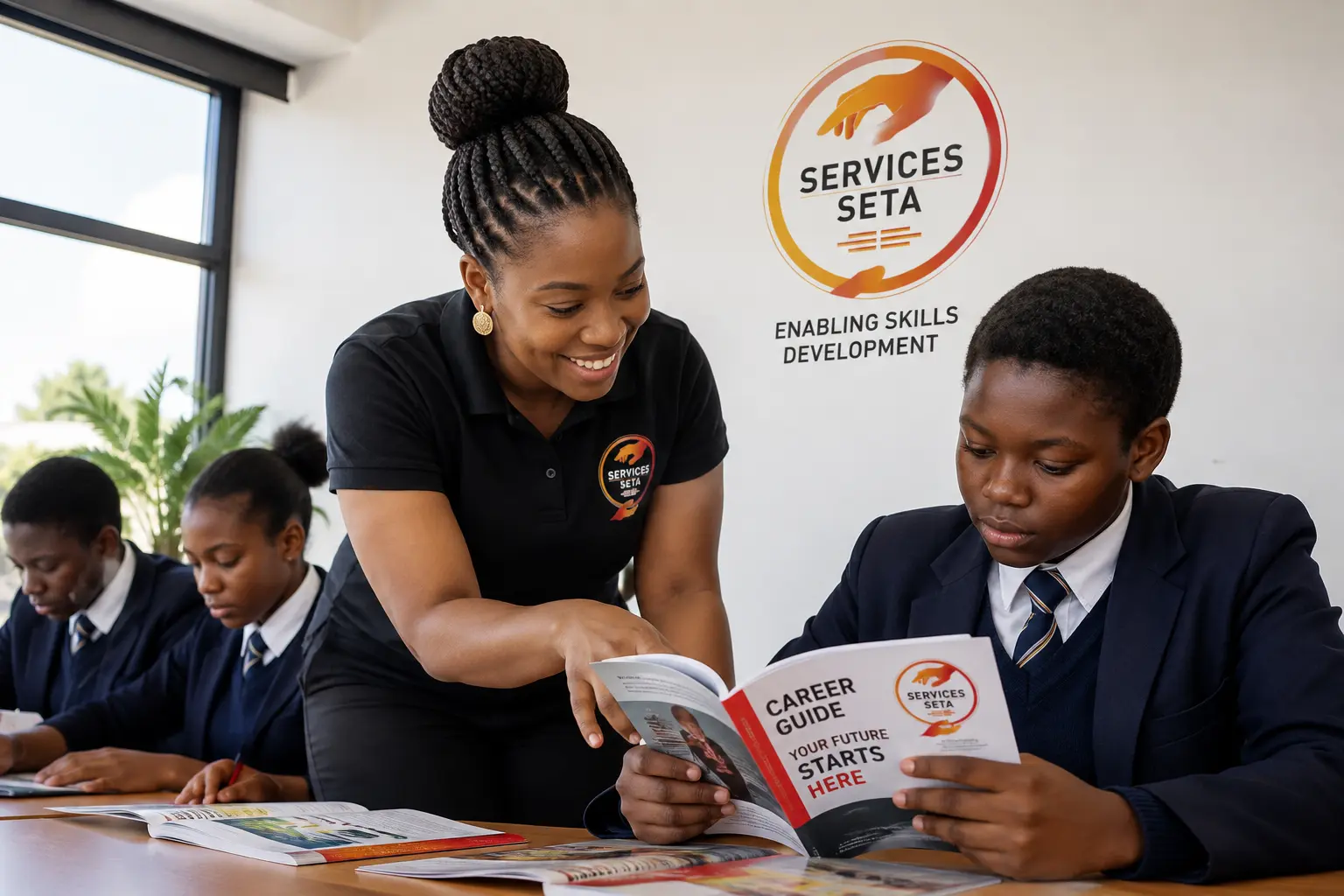
Around 450 high school learners from the Mkhambathini Area in KwaZulu-Natal participated in an education initiative at Esidadeni, in which reading, career guidance and personal development were prioritised.
The initiative brought together Services SETA, the RedBookshelf Foundation, Durban University of Technology (DUT), Nedbank, Mangosuthu University of Technology (MUT), Icebolethu Group Foundation and Berea Group of Colleges, with the aim of promoting the value of reading and providing learners with guidance about future study and career options.
The event highlights an important aspect of preparing for the workforce: ensuring that learners have the knowledge and confidence to make good decisions before leaving school.
Reading used as a foundation for development
The engagement at Esidadeni placed reading at the centre of the discussion.
Reading regularly can contribute to the development of language skills, comprehension and the ability to think critically about ideas and perspectives beyond one’s own experience.
By encouraging learners to see reading as something beneficial to all areas of their lives, the initiative was able to take a holistic approach to reading and development.
For learners who are on the verge of making important decisions about what to study, further education and career choices, being equipped with information is of particular importance.
Career guidance gives learners a wider view of their options
Another significant component of the engagement was career guidance, which helped learners to consider their options more broadly.
Learners were encouraged to think about diverse career opportunities, and to understand the various forms of further education and skills development that may be beneficial depending on the chosen path.
Learners who are newly considering their future often have the impression that a decision about a career has to be final right from the start.
In reality, factors such as further education, occupational training, universities, TVET colleges and workplace learning can be combined or sequenced according to the individual’s needs and interests.
Universities and organisations bring different perspectives
The involvement of universities and other organisations added to the value of the engagement, which is an example of the kinds of partnerships that can help to deliver career and personal development information to communities.
Durban University of Technology and Mangosuthu University of Technology represent the higher-education sphere, while Services SETA works in the broader skills-development landscape.
The involvement of Nedbank and the various foundations and education organisations also reflects the value of collaboration between a variety of groups in order to bring information to learners.
The value of engagements such as this one for learners is that they can receive detailed information about the options available to them, and they have direct access to ask clarifying questions.
Why early career guidance matters
Career decisions can have far-reaching consequences, which means that it is important for young people to have a realistic understanding of the options available to them, rather than basing a choice on a recommendation or a popular opinion.
Exposure to different career opportunities early on allows sufficient time for learners to conduct their own research about the subjects and entry requirements for tertiary education, as well as possible funding opportunities such as bursaries.
Careers guidance can also help young people to be more aware of their own interests and strengths, and to make a decision based on these rather than on what others expect of them.
Career guidance does not have to dictate a choice; rather, it should equip learners with information so that they feel equipped to make their own decisions.
Skills development starts before entering the workplace
Another important theme in the Esidadeni engagement is the relationship between reading and career decisions, and the way in which these tie into a broader perspective on skills development.
Skills development does not start only when learners enter the workforce; in fact, many of the skills needed in further education and in the workplace can be developed while they are still at school.
Learners can build core skills such as communication, comprehension and problem-solving, as well as research skills needed to access the wealth of information about further education, bursaries, learnerships, internships and jobs that is available online.
Unemployed young South Africans, in particular, can benefit from having a broad knowledge of the various options for further education and skills development, in order to plan for the future labour market.
A community-focused approach to career awareness
By holding the event at Esidadeni, the engagement ensured that learners received the information directly, without having to travel to KwaZulu-Natal from other parts of the country.
This aspect is significant because, although there are many excellent career guidance services and university open days, learners have unequal access to them, depending on where they live.
Community-focused events can help to bridge this divide by bringing universities, skills development organisations and potential employers into contact with learners.
The long-term impact of these engagements will be measured in terms of whether learners are able to use the information they have received to start the process of making decisions about further education and skills development.
What learners can do after a career-guidance event
Learners who attend a career-guidance event of this nature can make the information more useful by taking some practical steps.
They can:
Write down the careers of interest.
Research the subjects needed to obtain the relevant qualifications.
Explore the various routes, such as university, TVET college or occupational training.
Check the admission requirements of the preferred universities or colleges before selecting subjects at school.
Investigate the various bursary options available, and only deal with legitimate organisations.
Consult with teachers or registered career advisers for more information if they have any questions.
Keep a record of any useful contact details and websites that were shared at the event.
Avoid paying any individual for a guaranteed admission, bursary or job opportunity.
A learner does not have to decide about a full career path at once: it is a process that may unfold over several years.
It is important to stay informed and to keep developing new skills, while ensuring that the options available are applicable and accessible.
Reading, information and opportunity
The message of the Esidadeni engagement reaches far beyond the information that was shared on the day of the event.
Having access to accurate information is an important factor in the way in which young people make decisions about their futures, and reading enables learners to develop the skills to access, interpret and apply information about further education and careers.
The event offered the 450 participants an opportunity to learn about aspects of personal development and to understand the various options that exist after school.
It is vital that these events create a culture in which learners are encouraged to be informed and to make careful decisions as they progress towards the next stage in their education and their working lives.
Source and reporting note
This article is based on information provided about the Services SETA partnership initiative at Esidadeni in KwaZulu-Natal, including the participating organisations and the reported number of learners reached.
The article adds independently written context about reading, career guidance and skills development, without attributing additional claims or statistics to the participating organisations, unless the details have been provided.
Editorial policy
Our reporting aims to provide South African readers with factual, useful and independently written information.
We distinguish between confirmed information about an event and general educational guidance. We do not guarantee that participation in a career-guidance initiative will lead to admission, funding, training or employment.
Readers should verify education, bursary, learnership and career information directly with the relevant institution or organisation before making decisions.
Disclaimer and reader awareness
This article is for general information and public awareness. It is not an official publication of Services SETA, any participating university, foundation, bank or college.
Education and career requirements can change. Learners and parents should check current requirements directly with institutions before applying for courses, funding or skills-development programmes.
Awareness: No career event can guarantee a job or qualification. Learners should be cautious of anyone using the name of a government agency, university, bank or foundation to request money in exchange for admission, employment or a supposedly guaranteed opportunity.
