
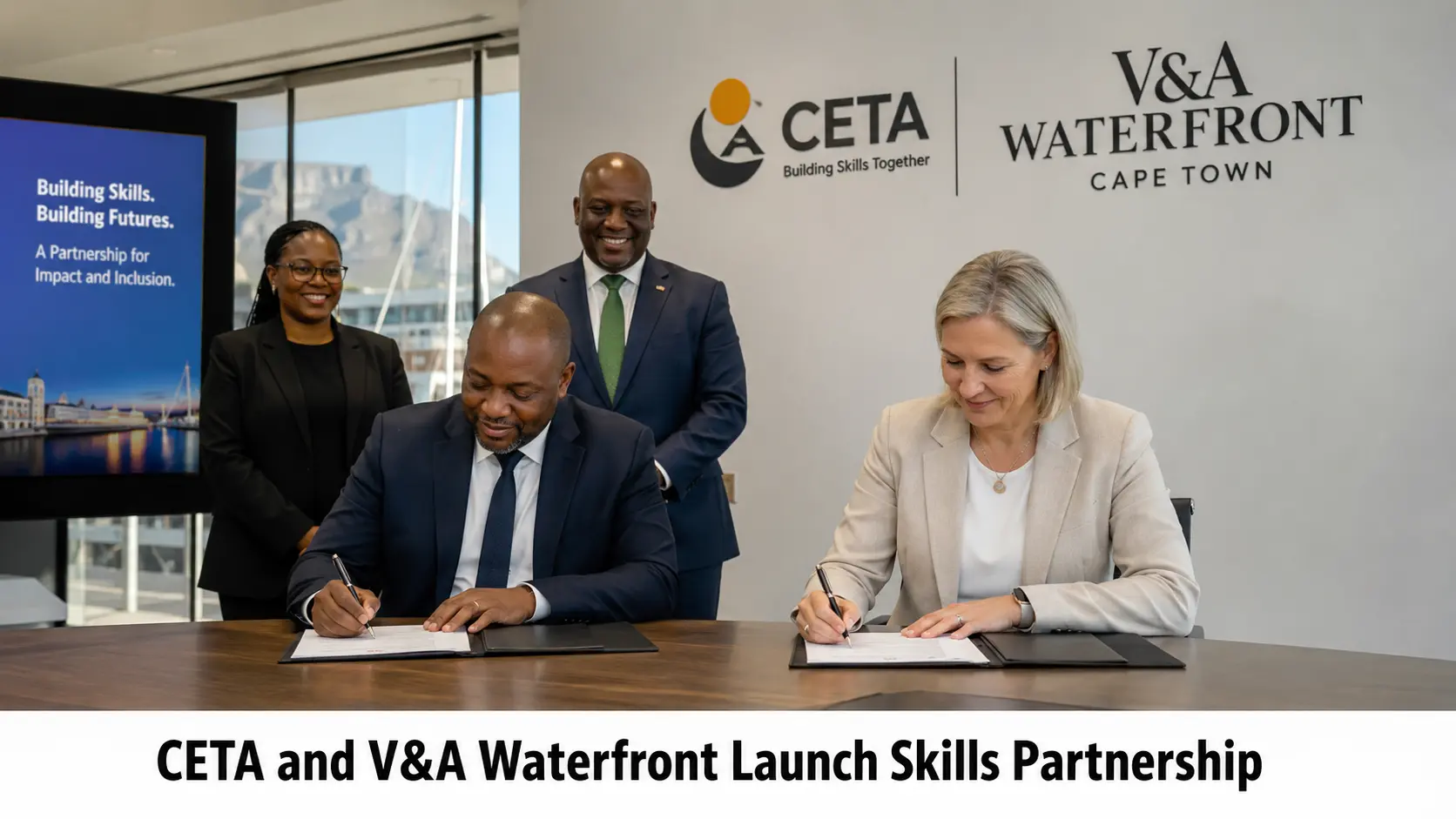
The Construction Education and Training Authority (CETA) has partnered with the V&A Waterfront on a major work-integrated learning initiative linked to the precinct’s long-term development plans in Cape Town.
The partnership is intended to connect infrastructure development with skills training and practical workplace experience, giving learners an opportunity to spend a significant portion of their training in real working environments.
The initiative brings together CETA and several other Sector Education and Training Authorities (SETAs), including the Transport Education and Training Authority (TETA), CATHSSETA, the Wholesale and Retail SETA (W&R SETA) and Services SETA.
The development linked to the partnership is expected to involve substantial investment over the coming years, while the skills programme is designed to help young people gain practical experience in construction, retail, hospitality, transport and related areas.
What the CETA and V&A Waterfront Partnership Means
The partnership is built around Work-Integrated Learning (WIL), an approach that combines structured learning with practical workplace exposure.
According to the information released about the initiative, learners will spend more than half of their training on site, rather than spending all their time in a classroom.
This is significant because practical workplace exposure can allow learners to develop skills in an environment where they can apply what they have learned.
Higher Education and Training Minister Buti Manamela described the development as more than a construction project, highlighting its potential role as a learning and training environment for unemployed young people.
The partnership also reflects the government’s broader focus on expanding Work-Integrated Learning opportunities through partnerships between education and training institutions and major employers.
V&A Waterfront Development and Economic Opportunity
The skills initiative is connected to the V&A Waterfront’s long-term expansion plans.
The V&A Waterfront itself describes the planned Granger Bay development as a R20 billion-plus project over the next 15 to 20 years, involving new homes, hotels, jobs, public space and coastal infrastructure.
Earlier reporting on the proposed development put the overall investment at approximately R24 billion and highlighted significant potential employment during construction and operation. A government-linked environmental process reported an estimated 26,929 construction-phase jobs and approximately 5,105 operational jobs over 20 years for the proposed reclamation project.
These figures are important, but they should not be interpreted as a promise that 120,000 vacancies will be advertised to job seekers.
The employment figures associated with large developments generally include direct and indirect economic activity across multiple years and sectors.
CETA’s Role in the Skills Programme
CETA is the lead partner in the work-based skills and learning initiative.
Its mandate is to support skills development in the construction sector and address critical and scarce skills. CETA states that it funds learning programmes including learnerships, apprenticeships, internships and skills programmes, as well as bursaries at public education and training institutions.
For the V&A Waterfront initiative, CETA has reportedly allocated R320 million over three years.
The investment is intended to support training and workplace learning linked to the development rather than simply funding classroom-based education.
CETA administrator Oupa Nkoane said the initiative could serve as a model for similar partnerships in the future.
He also indicated that CETA was expected to announce another comparable partnership with Airports Company South Africa (ACSA).
Learners to Gain Practical Workplace Experience
One of the central features of the partnership is the amount of time learners are expected to spend in actual workplaces.
Instead of completing most of their training in a classroom, participants will spend more than half of their training on site, according to the information released about the programme.
This can expose learners to:
- Real workplace environments
- Construction activities
- Professional teams
- Workplace procedures
- Practical skills
- Industry expectations
- Problem-solving
- Health and safety practices
- Communication and teamwork
The exact qualifications, learner intake numbers, application requirements and application dates for individual programmes have not been provided in the information available for this article.
Other SETAs Involved
The partnership extends beyond construction.
The participating SETAs include:
| SETA | Potential sector focus |
|---|---|
| CETA | Construction and built environment |
| TETA | Transport |
| CATHSSETA | Culture, arts, tourism, hospitality and sport |
| W&R SETA | Wholesale and retail |
| Services SETA | Services sector |
The involvement of several SETAs is intended to broaden the skills-development opportunities associated with the development.
This is particularly relevant because a large precinct such as the V&A Waterfront includes many different types of businesses and activities beyond construction.
Retail and Business Opportunities
The Wholesale and Retail SETA is participating because of the V&A Waterfront’s significant retail component.
W&R SETA chief executive officer Tom Mkhwanazi highlighted the precinct’s role as a major shopping destination.
The partnership is expected to provide learners with exposure to retail-related opportunities, while the development could create additional opportunities for people with relevant skills once new facilities become operational.
The initiative also includes an entrepreneurship component.
This means the programme is not focused exclusively on preparing learners for traditional employment. It also recognises the potential for participants to pursue business opportunities.
National Skills Fund Support
The National Skills Fund (NSF) is another important part of the broader skills-development ecosystem.
NSF chief executive officer Melissa Erra said successful programmes can potentially be scaled up and replicated through other partnerships.
The fund also supports artisans and other skilled workers who want to become entrepreneurs by helping with tools and entrepreneurship training, according to the information provided.
This approach could be important for learners who want to move from training into self-employment or small-business activity.
Upcoming V&A Waterfront Developments
The V&A Waterfront has a number of long-term development plans.
According to the Waterfront’s official information, the Granger Bay project is planned to include:
- New residential opportunities
- Hotels
- Public spaces
- Coastal protection infrastructure
- A new coastal walkway
- Recreational opportunities
- A protected bay
The Waterfront says the project is expected to unfold over approximately 15 to 20 years.
The proposed development is therefore not a short-term project. Its scale means that the associated skills and employment opportunities are expected to develop over a long period.
What This Could Mean for Young South Africans
For unemployed young people, the most important aspect of the partnership is the emphasis on learning while gaining workplace experience.
Work-integrated learning can help bridge the gap between qualifications and workplace requirements.
Participants who successfully complete relevant programmes may gain:
- Practical experience
- Industry exposure
- Technical skills
- Workplace discipline
- Communication skills
- Teamwork experience
- Entrepreneurial knowledge
- A recognised qualification, depending on the specific programme
However, participation in the broader development should not automatically be interpreted as a guarantee of employment.
Individual learnerships, internships, apprenticeships and other programmes will have their own eligibility requirements and application processes.
Will the V&A Waterfront Project Create Jobs?
The project is expected to generate substantial economic activity and employment over its development period.
The V&A Waterfront’s current information says the precinct supports around 30,000 direct jobs, while its broader economic ecosystem accounts for significantly more employment.
For the proposed Granger Bay expansion, government-linked environmental documentation cited approximately 26,929 construction-phase jobs and around 5,105 operational jobs over 20 years.
These are projected employment impacts, not a current list of vacancies.
Job seekers should therefore wait for official advertisements before assuming that a particular position is available.
Is There a V&A Waterfront Learnership Application Open?
The partnership announcement itself should not be treated as a current learnership application advertisement.
The information available does not provide a general application form, closing date or application link for all young people wanting to participate.
Applicants should only apply when a specific programme is officially advertised and should check:
- The name of the programme.
- The SETA responsible for the programme.
- The qualification being offered.
- Minimum requirements.
- Location.
- Stipend or financial support, where applicable.
- Application method.
- Closing date.
This is particularly important because different SETAs may advertise their own programmes separately.
Where to Find Official Updates
For CETA-related opportunities and announcements, applicants should monitor the official CETA website and its latest updates.
Visit the official CETA website
The V&A Waterfront also publishes information about its development projects, economic impact and social programmes on its official website.
Visit the official V&A Waterfront website
Applicants should be cautious of social-media posts claiming to offer guaranteed jobs or learnerships connected to the R24 billion development unless the opportunity can be verified through an official source.
Frequently Asked Questions
What is the CETA and V&A Waterfront partnership?
It is a work-integrated learning partnership linking skills development with the V&A Waterfront’s long-term development activities.
Which SETA is leading the initiative?
CETA is the lead partner in the work-based skills and learning programme.
Which other SETAs are involved?
The partnership includes TETA, CATHSSETA, W&R SETA and Services SETA, alongside CETA.
How much has CETA allocated to the project?
CETA has reportedly allocated R320 million over three years to the V&A Waterfront project.
Will learners receive practical experience?
Yes. The programme is designed around work-integrated learning, with learners expected to spend more than half of their training on site.
Will the project create jobs?
The development is expected to support substantial employment over its construction and operational phases. However, projected job numbers should not be interpreted as current vacancies.
Is there a specific learnership application open?
The partnership announcement does not provide a general application process for a V&A Waterfront learnership.
What sectors could benefit from the partnership?
The participating SETAs cover construction, transport, tourism and hospitality, wholesale and retail, and services.
Does the programme include entrepreneurship?
Yes. Entrepreneurship is identified as an important part of the initiative.
What developments are planned?
The long-term plans include residential development, hotels, public spaces and coastal infrastructure, among other development components.
How long will the development take?
The V&A Waterfront currently describes the Granger Bay development as a 15- to 20-year project.
Key Takeaways
- CETA and the V&A Waterfront have partnered on a work-integrated learning initiative.
- The programme links skills development with major infrastructure and development activity.
- Learners are expected to spend more than half of their training on site.
- CETA has reportedly allocated R320 million over three years to the project.
- TETA, CATHSSETA, W&R SETA and Services SETA are also involved.
- The initiative includes a focus on employment, workplace learning and entrepreneurship.
- The V&A Waterfront’s broader Granger Bay development is a long-term R20 billion-plus project, with earlier estimates putting the wider investment around R24 billion.
- Projected job figures represent economic and employment impacts over many years, not guaranteed vacancies.
- No general application form or closing date for a V&A Waterfront learnership is provided in the partnership information.
- Young people should follow official CETA, SETA and V&A Waterfront channels for specific programmes and vacancies.
Editorial Policy
This article is based on information supplied about the CETA and V&A Waterfront partnership and cross-checked against publicly available information from the official CETA and V&A Waterfront websites and government-related reporting.
We distinguish between confirmed programme information, long-term development plans and projected employment figures. Projected job numbers are not presented as guaranteed vacancies. We do not publish an application link, stipend amount, qualification requirement or closing date unless it is contained in an official vacancy or programme announcement.
Readers should verify individual learnership, internship, apprenticeship and employment opportunities through the relevant SETA, employer or government source before submitting personal information.
Official Sources and References
- CETA – Official Website
- CETA – Mandate and Purpose
- V&A Waterfront – Official Company Information
- V&A Waterfront – Sustainability and Social Impact
- Government-related reporting on the proposed Granger Bay development and projected employment impact.
Tip for Job Seekers
Do not treat the announcement as an open job or learnership application. The partnership is a long-term skills-development initiative. If specific learnerships, internships, apprenticeships or jobs become available, check the official advertisement for the exact requirements, stipend or salary, application method and closing date before applying.
