
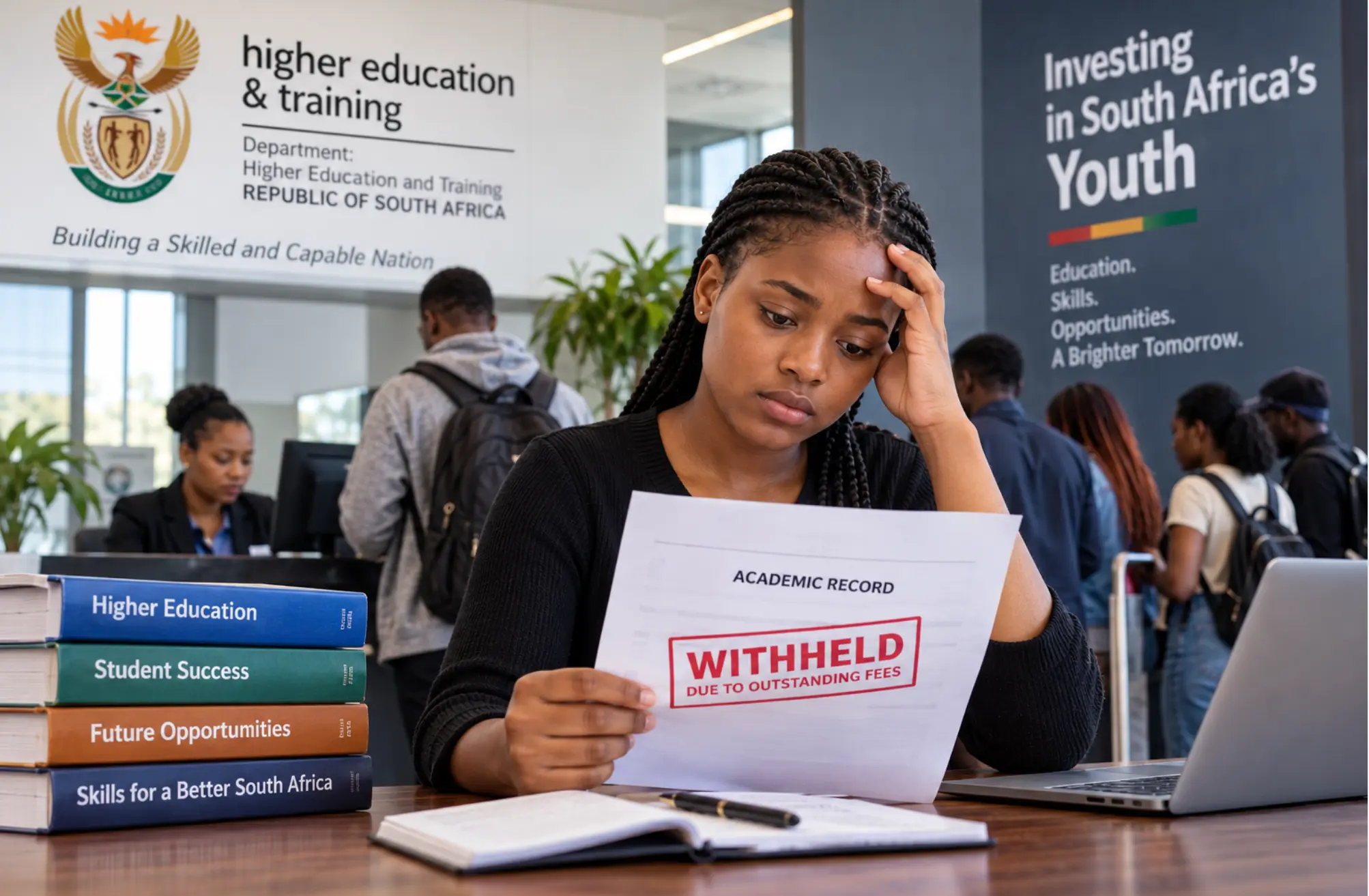
South Africa’s student debt figures have shot up to R59 Billion, with universities and colleges withholding hundreds of thousands of academic certificates due to student fees, reports show.
The figures have caused concern with lawmakers, as affected students will find it difficult to apply for jobs, hindering their ability to deal with the outstanding amounts.
The Portfolio Committee on Higher Education and Training heard the figures during a briefing which included the Department of Higher Education and Training (DHET), Universities South Africa (USAF) and the South African Public Colleges Organisation (SAPCO).
165,000 certificates withheld, DHET says
DHET reported to the committee that around 165,000 qualification certificates are currently withheld due to student debt.
USAF’s figures showed a higher number, with universities having 188,209 withheld certificates.
The discrepancy was not explained in the parliamentary report and should not be seen as reconciled numbers.
Nevertheless, the figures still serve as a stark reminder of the burden of outstanding student debt being carried by thousands of graduates who have completed their studies but are still in debt with their universities or colleges.
Why withheld certificates are a growing concern
Qualification certificates can serve as important documents for graduates seeking employment or needing to prove that they have successfully completed a qualification.
This puts graduates who have left university or college in debt in a challenging position.
They may face greater hurdles in finding employment if they are unable to provide documentation showing they have the necessary qualifications.
And without employment graduates may find it even more difficult to clear the debt they have with their former educational institution.
Chairperson of the committee Tebogo Letsie warned that this creates a detrimental feedback loop, where the ability of graduates to enter the job market and pay off the debt they owe is impeded.
NSFAS-linked debt makes up lion’s share of figures
According to the information shown to the committee, R29 billion of the reported student debt was linked to NSFAS-funded students, with R26 billion related to self-funded students.
The report also mentions an irrecoverable debt of R12 billion.
The figures should be treated with care, as they do not show a mathematical reconciliation to the separately mentioned R59 billion overall student debt figure.
The categories referenced may well use different reporting methods or bases.
The general message shown by the briefing was that the student debt issue is not limited to any particular category of student or educational institution.
Rising accommodation costs impacting student debt
Student accommodation has become a matter of concern.
The committee was told that increasing accommodation costs are creating a burden for thousands of students and contributing to outstanding student debt.
Some of the factors mentioned include:
Affordable student accommodation shortages
Growing private accommodation costs
Transport costs going up
NSFAS accommodation payment delays
Charges above NSFAS funding caps
Reconciliation issues with NSFAS
The problems can result in universities and students being left with outstanding balances even if the funding was provided or expected to be received.
Universities of technology have highest debt ratios
DHET indicated that universities of technology have the highest debt ratios, but traditional universities still have substantial debt.
The figures suggest the issue is found across all categories of higher education, rather than a matter restricted to universities of technology.
The committee also heard that NSFAS and institutions reconciliation problems are a factor affecting student debt.
CPUT, DUT and North-West University have highest recorded debts
USAF gave the committee figures showing the size of outstanding debts for a number of universities.
According to the figures given:
Cape Peninsula University of Technology (CPUT): around R4.2 billion
Durban University of Technology (DUT): around R4.1 billion
North-West University: around R3.8 billion
USAF also indicated that Tshwane University of Technology (TUT) had the highest number of withheld certificates among the listed universities, with 24,394.
This was followed by DUT with 23,155 and CPUT with 16,196 withheld certificates.
TVET colleges affected by student debt too
The problem is not limited to universities.
SAPCO told the committee that over 20,950 certificates were being withheld in the technical and vocational education and training college sector.
Sekhukhune TVET College accounted for 10,452 of those certificates, with Letaba TVET College having 5,543, according to the figures shown to the committee.
SAPCO also indicated that some of the outstanding debts pre-dated the 2007-2010 period, showing that some issues had been dragging on for a considerable time.
Does current student debt intervention strategy work?
The level of outstanding student debt has prompted concern about whether current interventions are working.
Letsie indicated that the increasing amounts of student debt suggested that the current interventions were not having the intended impacts.
He also added that dealing with the student funding issue is important both for students and for the stability of the universities and post-school education system.
Committee members also expressed concerns regarding students being caught between institutions and NSFAS if financial or reconciliation issues remain.
Universities have legitimate interest in retrieving outstanding student debt
The matter is far from being as simple as whether universities should be able to pursue unpaid student fees.
DHET Director General Dr Nkosinathi Sishi said that the department has been seeking legal clarity on the issue of certificate withholding and academic transcript retention.
According to the legal opinion presented to the committee, universities are autonomous bodies with contractual relationships with their students and hold a legitimate obligation to retrieve outstanding monetary amounts.
However, the opinion also recognised the hardship this can cause students and concluded that certificate withholding and transcript retention do not, in and of themselves, remove any constitutional rights so long as universities continue to provide proof of qualification completion and academic transcripts where necessary or appropriate.
This is important for graduates who must provide proof of qualification but still have outstanding student debt.
The bigger question: can students get on with their lives?
From the perspective of students and graduates, the immediate question tends to be more about practical matters than the overall R59 billion national student debt figure.
Graduates may need to know if they will be able to access their academic records, prove that they have completed a qualification and seek employment while clearing their outstanding student debt.
The debate has been informed by the concerns expressed by the committee that the unresolved financial issues were impeding the ability of graduates to enter the job market.
Without proof of their qualification, the impact of the university’s financial records can extend far beyond an institution’s own books.
Does a comprehensive student funding solution need to be found?
The committee has indicated that a comprehensive student funding solution needs to be found.
Letsie also warned against the implications of NSFAS failure, arguing that universities and other stakeholders will have a vested interest in making sure that the funding scheme continues to operate.
The committee has called for increased cooperation between DHET, NSFAS, USAF and universities to address outstanding issues, instead of leaving the problems to fester and impact students.
What it all means for South Africa’s graduates
The parliamentary briefing has underlined a complex set of challenges impacting South Africa’s post-school education system.
Student debt not only impacts university finances but can ripple out to determine whether graduates receive the proof of qualification they need, whether universities are able to maintain their viability and whether government student funding initiatives are working effectively.
The challenge now is to find solutions which protect an institution’s legitimate interests in retrieving outstanding student debt, but which do not result in graduates who have finished their studies being unable to access the labour market because of their student debt.
For thousands of students and graduates, the outcome of that debate could determine whether finishing a qualification leads on to a job or another layer of financial problems.
Source and reporting note
This article is independently written using information presented by the Portfolio Committee on Higher Education and Training and published by the Parliament of South Africa. The figures relating to student debt, withheld certificates, universities and TVET colleges are attributed to DHET, USAF and SAPCO as reported to the committee.
Where figures presented in the parliamentary report do not reconcile this article does not present a combined figure, but instead attributes the number to the organisation which gave the figure.
Editorial policy
We aim to report higher education and student funding developments accurately and in context. Figures supplied by different institutions are attributed to their respective sources, particularly where reporting methodologies or totals differ.
Disclaimer
Student debt policies and certificate-release practices can differ between institutions. Students affected by outstanding fees should contact their university or TVET college directly to establish what academic records, proof of qualification or other documentation may be available to them while their debt is being resolved.
