
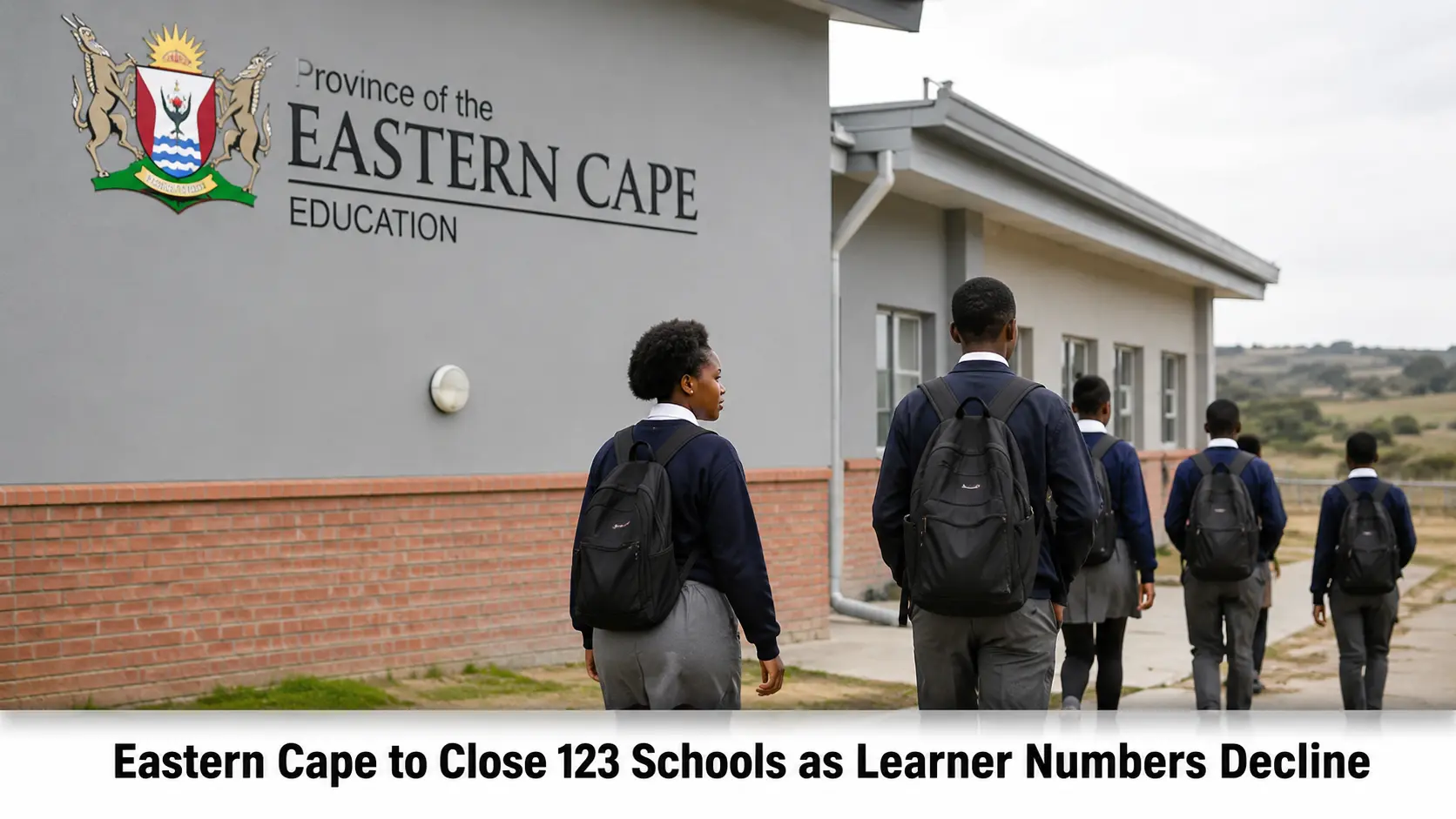
The Eastern Cape Department of Education has confirmed plans to close 123 schools during the coming financial year, citing declining learner enrolment and the resulting impact on the allocation of teachers and other education resources.
A further 300 schools have been earmarked for closure in the years ahead, as the provincial department continues with a broader rationalisation programme aimed at consolidating under-enrolled schools.
The decision is expected to have its greatest impact on rural communities, where schools can serve relatively small and widely dispersed populations.
The department says affected learners will be moved to other schools as part of the rationalisation process, with government working on transport arrangements to help learners reach their new schools.
The issue has attracted attention because school closures can have a significant effect on learners, families, teachers and rural communities.
Eastern Cape School Closure Plan at a Glance
| Category | Details |
|---|---|
| Province | Eastern Cape |
| Department | Eastern Cape Department of Education |
| Schools confirmed for closure | 123 |
| Additional schools earmarked | 300 |
| Main reason | Declining learner enrolment |
| Main impact | Rural communities |
| Planned response | School mergers and learner relocation |
| Transport support | Government departments are expected to assist |
| Broader objective | Rationalise schools and improve resource allocation |
Why Are 123 Eastern Cape Schools Being Closed?
The provincial education department says the main reason is declining learner numbers.
Eastern Cape Department of Education spokesperson Malibongwe Mtima explained that schools are resourced according to learner numbers.
When enrolment falls significantly, schools can receive fewer teachers and fewer resources, making it increasingly difficult for the department to maintain them at their existing size.
The department therefore considers some schools to be no longer viable at their current enrolment levels.
The planned closures form part of a wider rationalisation process, in which under-enrolled schools can be merged with nearby schools.
The department argues that consolidation can allow limited education resources to be concentrated in schools with larger learner populations.
What Does School Rationalisation Mean?
School rationalisation generally involves reviewing schools based on factors such as learner numbers, available resources and the practicality of maintaining separate institutions.
In this case, the Eastern Cape department says schools with declining enrolment may be merged with other schools.
Rather than continuing to maintain very small schools with limited resources, learners can be moved to another nearby institution.
The objective is to make better use of available teachers, infrastructure and other resources.
However, the process can be particularly challenging in rural areas where schools may be far apart.
Rural Learners Could Be Most Affected
The department has acknowledged that rural communities will be affected by the closures.
In many rural areas, schools are an important part of local communities and may be located considerable distances from alternative schools.
Closing a nearby school can therefore increase the distance learners need to travel each day.
The department says it is working with other government entities to address the transport implications.
The intention is to ensure that learners affected by mergers can travel safely to their new schools.
Government Plans Transport Support for Affected Learners
One of the major concerns surrounding school closures is how learners will reach their new schools.
According to the department, the rationalisation process involves coordination with other government officials, including those responsible for transport.
The aim is to provide transportation where necessary after schools are merged.
This is particularly important for rural learners who may not have convenient public transport options.
The availability and implementation of transport arrangements will therefore be an important part of the process for affected communities.
300 More Schools Earmarked for Future Closure
The 123 schools are not the end of the province’s rationalisation programme.
The department has also identified approximately 300 additional schools for possible closure in the coming years.
These schools form part of a longer-term process aimed at addressing declining enrolment and improving the distribution of education resources.
However, the additional 300 schools should not automatically be described as schools that will all close immediately.
They are part of the department’s broader future rationalisation plans.
This distinction is important for parents, learners and communities trying to understand what the announcement means for their individual schools.
What Happens to Learners When a School Closes?
Learners affected by school closures are expected to be relocated to other schools, particularly schools that can accommodate the additional learners.
The department’s approach involves merging schools where appropriate rather than simply removing education services from communities.
The relocation process can involve several considerations, including:
- The receiving school’s capacity
- Distance between schools
- Learner transport
- Teacher allocation
- Available classrooms
- Infrastructure
- Grade availability
- The needs of affected learners
The exact arrangements will depend on the schools and communities affected.
What Happens to Teachers?
Declining learner numbers can affect teacher allocations because education departments generally determine staffing requirements partly according to learner enrolment.
The Eastern Cape department says shrinking enrolment means some schools may not have enough learners to justify their existing level of staffing and resources.
School rationalisation is therefore also intended to improve how teachers and other resources are distributed.
Teachers affected by school mergers may consequently be subject to the department’s broader staffing and placement processes.
The information currently available does not provide a school-by-school breakdown of teacher placements.
Why the Eastern Cape Is Consolidating Schools
The department says the closures are necessary to support sustainable education delivery in the province.
The Eastern Cape has faced significant education infrastructure and resource challenges over the years.
Maintaining a large number of very small schools can place pressure on available resources, particularly where learner numbers continue to decline.
By consolidating schools, the department believes it can concentrate teachers, infrastructure and other resources where they are most needed.
The policy therefore reflects a tension between efficient resource allocation and the importance of maintaining accessible schools in rural communities.
School Closures and Community Concerns
Although the department has explained the financial and resource reasons behind the rationalisation programme, school closures can be difficult for communities.
Parents may have concerns about:
- Increased travel distances
- Transport availability
- Learner safety
- Class sizes at receiving schools
- Teacher availability
- Infrastructure capacity
- The impact on rural communities
These issues make implementation particularly important.
A school merger may improve resource allocation on paper, but its success will also depend on whether the receiving schools have sufficient classrooms, teachers, facilities and transport arrangements.
Is the Eastern Cape Closing 123 Schools Immediately?
The department has confirmed 123 school closures for the coming financial year, with the process already being implemented at some facilities.
The additional 300 schools relate to the longer-term rationalisation programme.
Therefore, the figures should be understood as two separate groups:
123 schools: Confirmed for closure in the coming financial year.
300 schools: Earmarked for closure in the coming years as part of the broader rationalisation process.
What Parents and Learners Should Do
Families whose children attend schools potentially affected by the rationalisation programme should wait for information from the Eastern Cape Department of Education or their school regarding their specific circumstances.
Parents should confirm:
- Whether their school is included in the closure programme.
- Which school learners will attend after the merger.
- Whether transport will be provided.
- When the relocation will take place.
- How learner records will be transferred.
- Whether the receiving school has the required grades and capacity.
Parents should avoid relying solely on social-media lists claiming to identify all schools that will close unless those lists can be verified through an official government source.
What the Department Says About the Future
The Eastern Cape Department of Education says the rationalisation programme is a coordinated government effort, rather than a decision being implemented in isolation.
The department is working with other government entities to address issues arising from school mergers, particularly transportation.
The broader objective is to ensure that the province can continue providing education despite changing learner numbers and limited resources.
Frequently Asked Questions
How many Eastern Cape schools are being closed?
The department has confirmed plans to close 123 schools in the coming financial year.
Why are the schools being closed?
The main reason given is declining learner enrolment, which affects the allocation of teachers and other resources.
Are another 300 schools also closing?
The department has earmarked another 300 schools for closure in the coming years as part of the broader rationalisation programme.
Will learners be left without schools?
No. The department’s plan involves merging under-enrolled schools and relocating learners to other schools.
Will transport be provided?
The department says it is working with other government entities to ensure that transport arrangements are made for affected learners where necessary.
Which areas will be affected the most?
The department has acknowledged that rural communities are expected to be particularly affected.
Why does learner enrolment matter?
The department says teacher and resource allocation is linked to learner numbers. Declining enrolment can therefore result in fewer teachers and resources being allocated to a school.
Are the 300 additional schools already closed?
No. They have been earmarked as part of the longer-term rationalisation process.
Does this announcement affect all Eastern Cape schools?
No. The announcement concerns schools identified for rationalisation because of declining enrolment. Parents should confirm their individual school’s status through official channels.
When will the 123 schools close?
The department has indicated that the closures will take place during the coming financial year, with some closures already being implemented.
Key Takeaways
- 123 Eastern Cape schools are scheduled for closure in the coming financial year.
- The main reason is declining learner enrolment.
- The department says lower enrolment affects teacher and resource allocations.
- An additional 300 schools have been earmarked for closure in the coming years.
- Rural communities are expected to experience much of the impact.
- Learners affected by school mergers are expected to move to other schools.
- Government is working on transport arrangements for affected learners.
- The department says the rationalisation programme is intended to improve the use of limited education resources.
- Parents should verify whether their individual school is affected before acting on information circulating online.
Editorial Policy
This article is based on the latest reporting concerning the Eastern Cape Department of Education’s school rationalisation programme.
We distinguish between the 123 schools confirmed for closure in the coming financial year and the 300 schools earmarked for possible closure in future years. We do not describe the additional 300 schools as already closed.
The article also distinguishes between projected or planned transport arrangements and confirmed individual transport services. No school-specific closure list has been added unless verified through an official source.
Readers should confirm information about individual schools, learner relocation, transport and implementation dates directly with the Eastern Cape Department of Education or the relevant school.
Official Sources and References
- Eastern Cape Department of Education — provincial education authority responsible for school administration and rationalisation.
- Department of Basic Education — national education information and policy resources.
- News24 — reporting on the Eastern Cape’s decision to close 123 under-enrolled schools and the longer-term plans involving additional schools.
- Inside Education — reporting on the 123 confirmed closures, 300 additional schools and comments from Eastern Cape Education Department spokesperson Malibongwe Mtima.
Tip for Parents
If your child’s school may be affected, do not assume that closure means your child will lose access to education. Ask the school or Eastern Cape Department of Education where learners will be transferred, whether transport will be provided and when the change will take effect.
